How Resources Reveal Systems
Compiled from the 55 Minutes book, p. 193-201 and 513-522.
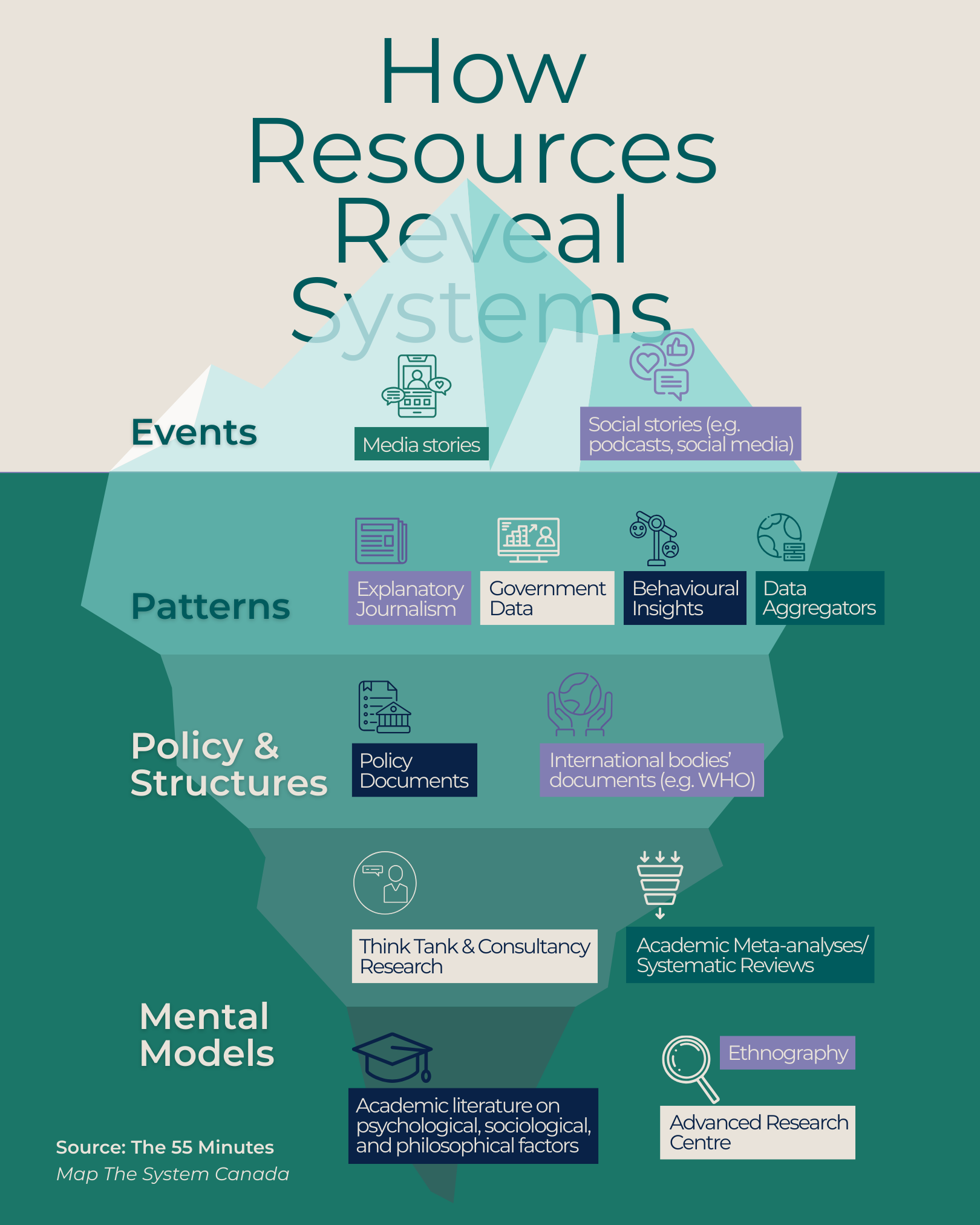
The Iceberg Model is used to structure and focus research by identifying the types of data required to understand a system at various depths. Moving from the visible tip into the deeper layers requires shifting from surface-level observations to more detailed, research-informed analyses.
The following resources are categorized according to the four levels of the iceberg:
1. Events (The Tip)
This level focuses on immediate occurrences and visible symptoms of a problem.
Media Stories: Initial research should focus on news coverage and media reports related to the concern to capture what is happening in the moment.
Social Media Feeds: Platforms such as TikTok and other vlogs can provide rapid, first-person insights into contemporary events and experiences.
2. Patterns
At this level, researchers look for recurring behaviours and trends over time to understand how events are linked.
Investigative and Explanatory Journalism: These sources provide context for current trends and may include in-depth analysis from collectives such as Bellingcat or academic-led summaries such as The Conversation.
Bellingcat: Bellingcat is a Netherlands-based investigative journalism group that specialises in fact-checking and open-source intelligence
The Conversation: Curated by professional editors, The Conversation offers informed commentary and debate on the issues affecting our world
Pew Research Centre: Pew Research Center is a nonpartisan, nonadvocacy fact tank that informs the public about the issues, attitudes and trends shaping the world.
Behavioural Insights and Government Data: Data from censuses or sensors ("big data") helps discern patterns in human behaviour and social situations.
Statistics Canada
Data Aggregators: Clearinghouses such as Statista and Our World in Data provide historical charts and datasets across various issue areas.
Gapminder: Offers complete datasets with hundreds of indicators available
Google Dataset Search: Listed among open data resources for finding publicly available datasets.
Worldometer: Real-time statistics on world population, economics, health, and more.
3. Policy and Structures
This layer examines the formal rules, physical structures, and organized behaviours that sustain the patterns.
Think Tank and Consultancy Research: Reports from organizations like Brookings or Deloitte, as well as watchdog alerts and auditors’ reports, help illuminate the policy layer.
Academic Meta-analyses and Systematic Reviews: These are the primary tools for understanding structures and behaviours. They pool statistics and synthesize evidence from many independent studies to provide a robust, comprehensive picture of a challenge.
Government and International Documents: Senate reports, public inquiries, and documents from international bodies (such as the UN or the OECD) reveal the regulatory and institutional frameworks governing a system.
4. Mental Models
The deepest level examines the fixed assumptions, beliefs, and cultural frames that sustain a system.
Foundational Analytical Works: Research at this level draws on psychological, sociological, philosophical, and literary works that offer perspectives from diverse cultural frameworks.
Thick Data and Ethnography: Qualitative insights from ethnographic studies, biographies, and lived experience help researchers understand the "swampy lowland" of human concern and the underlying assumptions of those within the system.
Advanced Research Centres: Organizations such as the RAND Corporation or CIFAR often investigate "sleeper" topics or foundational questions long before they reach the public or policy agenda.
To ensure the research is robust across these levels, the sources recommend looking for triangulation (consistency across multiple studies) and consilience (when different disciplines, such as neuroscience and economics, reach the same conclusion). Researchers could also use AI-enabled tools as adjuncts to help frame broader problems or identify overlooked system components, provided the information is independently verified.