How to Find Leverage Points in Complex Systems
—Compiled by Linh Bui, drawing from materials supplied by Katharine McGowan and Ashley Dion
By the time you’re looking for leverage points, you’ve already done the hardest work. You started with curiosity—a problem that pulled at you, a system you wanted to understand. That curiosity carried you through research, stakeholder perspectives, causal loops, and the iceberg model. Along the way, you felt the weight of the system: the root causes that stretch back generations, the structures designed by people with power for people with power, and mental models so old they barely feel like beliefs.
Now that you understand how deeply rooted the problem is, it’s time to figure out where to act.
Part of the Video Series: Overcoming Common Systems Thinking Challenges on YouTube
VIDEO SCRIPT INSIGHTS
What a Leverage Point Is
A leverage point is a small place in a system where a targeted change can create a big impact. Think of it like a lever: push in the right spot, and you move something much larger.
But remember: you’re not trying to fix everything at once. You’re trying to move the system from a 6 to an 8, not instantly to a 10.
Start by Finding the Gaps
Before thinking about solutions, ask: why is the system stuck?
Common gaps include:
Measurement gaps: The system only tracks certain numbers, missing the real issues people experience.
Power gaps: Decisions are made by those far removed from the problem, while the people most affected have little influence.
Perspective gaps: Certain voices or experiences are ignored, so the system doesn’t “hear” everyone.
Impact gaps: Side effects—like stress on communities, environmental damage, or long-term consequences—are overlooked.
Information gaps: Critical knowledge isn’t shared, or the wrong data drives decisions.
Spotting these gaps is the first step toward identifying where change could happen.
Look at Who is Affected and Who Has Power
Ask yourself two questions:
Who is most affected by this problem?
Who actually has the power to change it?
Often, the people closest to the problem have the least power, and those with power are far removed. This tension itself can12 Places to Intervene in a System reveal important leverage points.
Where Do Leverage Points Usually Exist?
Donella Meadows’ work on the “12 Places to Intervene in a System” Places to Intervene in a System” shows where change can be most effective:
Quantities and parameters
Feedback loops
Resource flows
Information flows
Rules of the system
Distribution of power
System goals
Mindset and mental models
One practical tool to help spot leverage points is the Six Conditions of Systems Change. It’s like the iceberg model without the top two layers (events and trends), helping you focus below the surface:
Policies: Rules and laws
Practices: How people and organizations act
Resource flows: Where money, time, and attention go
Relationships: Who collaborates with whom
Power dynamics: Who influences decisions
Mental models: Beliefs about how the system works
Change often starts in the visible layers—new policies, programs, or funding—but can gradually reshape relationships, power, and beliefs over time.
When using this tool, ask:
Where are people already acting?
Where could change realistically happen?
What could you do to move it forward?
“System boundaries relate to the system’s purpose. Analytical boundaries relate to your research purpose.”
Think About Change Over Time with Three Horizons
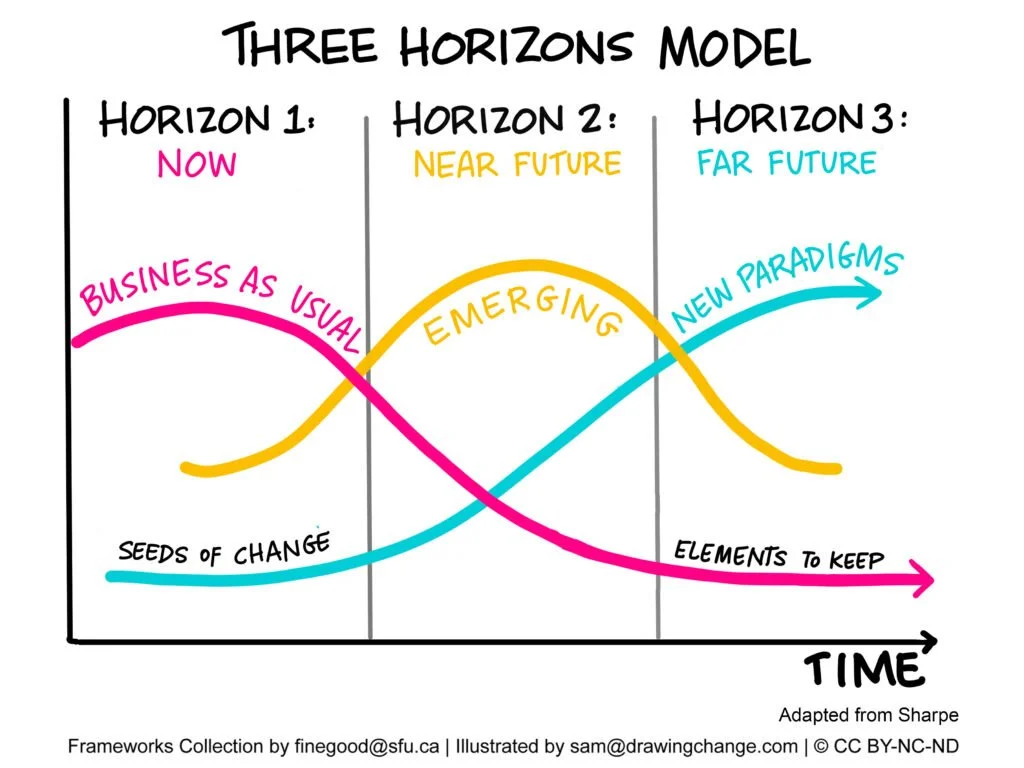
Another lens is the Three Horizons framework (Bill Sharpe):
Horizon 1 – The current system: How things work now, who benefits, who is harmed.
Horizon 2 – New experiments: Small alternatives already happening—community initiatives, pilot programs, innovative ideas. Some will fail, some will grow.
Horizon 3 – The future vision: What the system could look like if it truly worked for everyone. Not a utopia, but a direction for emerging experiments to grow toward.
All three horizons exist simultaneously. Your role is to spot Horizon 2 experiments that could grow and push the system toward a better future.
Or Think This Way: You Can Find Leverage Points According To Your Interest
Want to disrupt? Shift or increase information flow; drive a reinforcing loop to increase the rate of change. Reduce friction
Measuable variables
Measure rate of change
Threshold proximity?
Want to slow down?Slow a feedback loop, introduce some balancing behaviour, slow the rate of flow of information/action. Introduce friction
Measuable variables
Measure rate of change
Threshold proximity?
Want to shift behaviour? Change parameters, introduce new information flow structures, new feedback loops
Identify new behaviours
Identify new patterns
Stories to data
Want to build a new practice? Decouple action from mental models; align new action with existing mental models or new ones
Stories to data
Follow the disruption