How to Find Systems Boundaries
—Compiled by Linh Bui, drawing from materials supplied by Katharine McGowan and Ashley Dion
Setting boundaries is one of the most common challenges students have when they take a systems thinking approach to exploring a systemic issue. When students hear “set boundaries” in systems mapping, they often think it just means geography. It doesn’t.
Boundaries are how you decide what is in your system, what is out, and why. In systems thinking, it’s easy to see endless connections. Boundaries help you draw a line so you don’t go crazy, and so your exploration of systemic issues remains doable.
This article provides an explanation of how to find system boundaries, including a 5-minute video below and a written overview.
Part of the Video Series: Overcoming Common Systems Thinking Challenges on YouTube
Overview
What are system boundaries?
Boundaries are not just geography. In systems thinking, we view boundaries as our permissions to stop exploring and draw a line for the analysis to remain doable. The matter for research, mapping, and communicating your scope clearly.
They define:
What counts as relevant
What does not (for now)
What your system is actually about
As Donella H. Meadows writes in Thinking in Systems:
“There are no separate systems. The world is a continuum. Where to draw a boundary around a system depends on the purpose of the discussion.”
Similarly, Steven Shorrock reminds us:
“Where I choose to draw the system boundary will depend on my purpose, my understanding, and perhaps my scope for intervention.”
Your decisions are boundaries. And your boundary decisions are most informed after you zoom out first.
Common Misconceptions About Boundaries
Misconception #1: Research Is Linear
Most people think:
Research → Question → Analysis → Answer
In systems thinking, it’s more like:
Context sensing → Provisional boundary → Question → Exploration → Boundary revision → Sharper question → Deeper insight
You don’t need a definitive boundary before you start researching and mapping. In fact, you shouldn’t. You should zoom out first and explore the broader system related to your topic. As you do, you may discover your original question needs refining.
Your purpose guides your boundary, and your evolving question reshapes it.
Misconception #2: There Are Right and Wrong Boundaries
Most people think boundaries are objectively correct or incorrect. In reality, boundaries are artificial, especially in human systems. They are value-based and purpose-driven.
There are no perfectly “right” boundaries. There are only boundaries that are more or less useful for your purpose.
So If Boundaries Are Artificial, How Do We Draw Them?
Boundaries, though created for specific purposes and inherently artificial, are not arbitrary; they necessitate well-informed judgment.
The question becomes: How do we know what to look at, and when to stop?
The tools below are what we find helpful for identifying edges, parameters and layers possible for boundaries in your systems exploration.
Tool 1: Two Types of Boundaries
1. System Boundaries
All systems have purposes. Systems boundaries are related to the systems you are studying, where the connections stop helping explain the system’s purpose.
Examples:
Political systems often stop at jurisdictional limits.
Climate systems follow ecological boundaries.
Organizations stop paying attention at the edge of their authority or responsibility.
In human systems especially, boundaries are normative. They reflect:
What people inside the system care about
What they are trying to achieve
What they ignore
To understand a system’s purpose, look at:
Membership – Who is inside or outside?
Flow – What resources, information, or influence move?
Responsibility – Who is accountable?
Control – Who makes decisions?
2. Analytical Boundaries
Analytical boundaries relate to your research purpose. What questions are you trying to answer? What’s your purpose of answering this question? Where connections stop helping answer your question.
For instance, imagine you are researching the addictive qualities of social media to determine its impact on youth learning:
Algorithms matter.
User psychology matters.
Platform incentives matter.
Legislation might matter but only insofar as it shapes platform behaviour.
The biology of every individual user? Probably not central to your specific question.
“System boundaries relate to the system’s purpose. Analytical boundaries relate to your research purpose.”
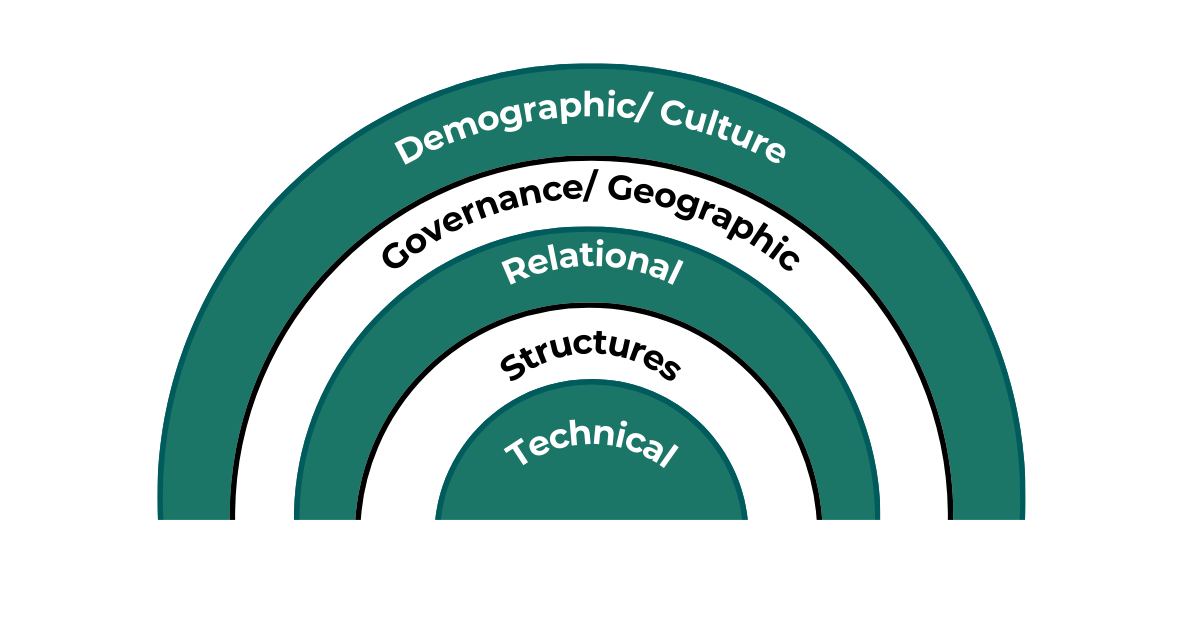
Tool 2: Layered Boundaries
In practice, different factors show up across different kinds of boundaries:
Technical boundaries–Skills, resources, money flowing in and out
Structural boundaries–Rules, institutions, norms, beliefs, power
Relational boundaries–Stakeholders, agencies, networks
Governance/geographic boundaries–Jurisdictions
Demographic/cultural boundaries–Whose outcomes are centered? Age? Identity? Community?
For example, a problem may exist across Canada, but your project may focus on Métis youth in one local context.
National laws may still matter. Local relationships and norms may matter even more.
Your focal population is Métis youth, but other actors can still appear in the map if they shape outcomes.
Three Steps for Setting Boundaries
Step 1: Ask Good Questions, using the Iceberg Model
The Iceberg Model helps prevent shallow analysis and premature boundary-setting.
Think of it like a layered Jenga tower. Each layer is stacked on the next:
Events
What just happened? What feels wrong?Patterns & Trends
Is this chronic? Who is involved? When and where does it occur?Underlying Structures
Policies, laws, incentives, punishments, social expectations — what structures shape the patterns?Mental Models
Beliefs and assumptions that justify the structures and keep the system in place.
If something doesn’t connect, if a rule floats without linking to a pattern or belief, something is missing. That tension is useful. It signals where to refine your question or boundary.
Helpful exercise:
Notice something that makes you angry or frustrated.
Resist jumping straight to “the system is broken.”
Use the iceberg to deepen your thinking first.
Boundaries often become clearer through this layered exploration.

McGowan, K. (2026, February 12). The iceberg model for boundaries [PowerPoint slides]. Curiosity to Clarity: Research Questions, Scope, and Boundaries workshop.
Step 2: Research to answer the questions in the iceberg model, and keep in mind the boundary types
Once you have meticulously used the Iceberg Model to ask increasingly profound questions, the next step is the active search for answers. This research phase is critical for moving from assumption to informed action. As you gather data to confirm or challenge your analysis of the four layers, continually benchmark your emerging understanding against the established categories of boundaries and even personal purposes (time, resources, etc.). This ensures your final boundary is not only rooted in the system's core problem but is also actionable and specific.
Step 3: Asking Better Questions and Seeing Clarity
The cyclical nature of this process is key. The answers you find in Step 2 will inevitably lead to even better, more precise questions. This iterative loop of questioning, researching, and refining allows you to see the problem not as a single event, but as a dynamic component within larger, nested systems (e.g., your personal system, your team's system, the organizational system). True clarity in boundary setting emerges when you understand how your boundary in one layer or system will ripple out and affect the others.
—
Strong systems maps do not include everything. They include the most influential pieces and justify each boundary. Hope this assists you in defining your boundaries, building upon the research you have and your clearer grasp of your areas of concern.